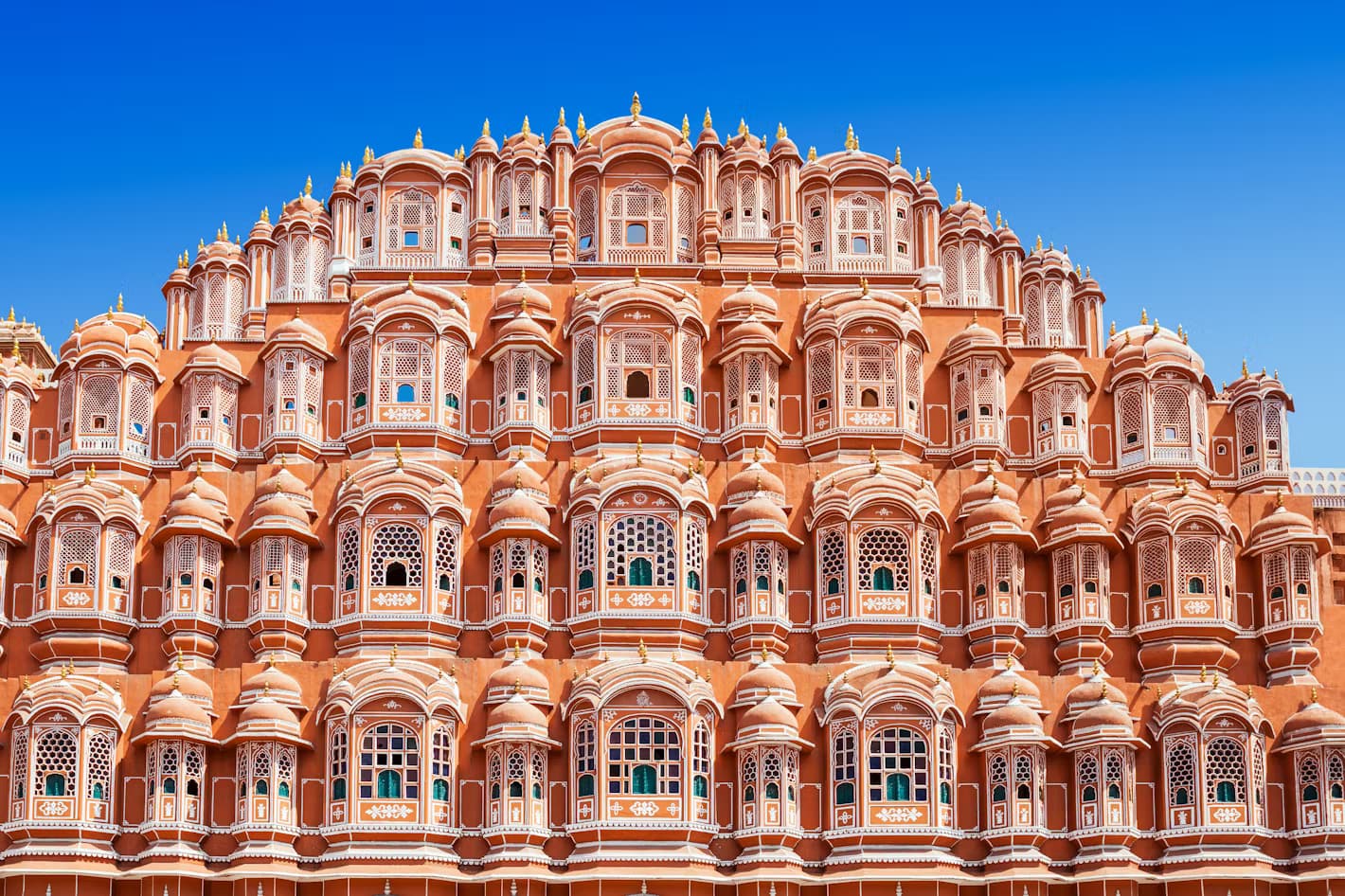
Hawa Mahal
Palace of Winds • The Pink City's Crown Jewel
About Hawa Mahal
Hawa Mahal, also known as the "Palace of Winds," is a stunning five-story palace in Jaipur, Rajasthan. Built in 1799 by Maharaja Sawai Pratap Singh, it was designed by Lal Chand Ustad as an extension of the City Palace.
The palace is famous for its unique honeycomb-like structure with 953 small windows called "Jharokhas," decorated with intricate latticework. These windows were designed to allow royal ladies to observe street festivities while unseen from the outside, following the strict rules of "purdah" (seclusion).
The structure is built from red and pink sandstone, giving it a distinctive appearance that matches the "Pink City" theme of Jaipur. The palace stands at an elevation of 50 feet from its base and is a perfect example of Rajput architecture with Mughal influences.
Historical Background
1799 - Construction Begins
Maharaja Sawai Pratap Singh commissions the palace as a summer retreat.
1800 - Completion
The palace is completed and becomes a royal observatory.
19th Century - Royal Residence
Used by royal women to observe street processions and festivals.
20th Century - Restoration
Major restoration work carried out to preserve the structure.
Present Day - Tourist Attraction
One of Jaipur's most visited landmarks and architectural marvels.
Architectural Marvel
Design Elements
- • 953 Jharokhas (windows) with latticework
- • Five-story pyramidal structure
- • Red and pink sandstone construction
- • Intricate carvings and motifs
- • Blend of Rajput and Mughal styles
Dimensions
- • Height: 50 feet (15 meters)
- • Width: 50 feet (15 meters)
- • Depth: 20 feet (6 meters)
- • Windows: 953 Jharokhas
- • Stories: 5 levels
Best Time to Visit
Early Morning (8:00 AM)
Best lighting for photography and fewer crowds.
Late Afternoon (4:00 PM)
Golden hour lighting and pleasant temperatures.
Evening (6:00 PM)
Beautiful sunset views and cooler weather.
Essential Visiting Tips
What to Bring
- • Comfortable walking shoes
- • Camera with wide-angle lens
- • Water bottle
- • Hat and sunscreen
- • Light clothing (it can get hot)
Important Notes
- • Best viewed from outside for full effect
- • Interior access limited to first two floors
- • Photography allowed throughout
- • Visit early morning for best photos
- • Combine with City Palace visit
Photography Guide
Best Photo Spots
- • Across the Street: Full facade view with street life
- • From City Palace: Elevated perspective
- • Close-up Details: Individual Jharokhas
- • Street Level: People and palace together
- • Sunrise/Sunset: Golden hour lighting
Camera Settings
- • Aperture: f/8 to f/11 for sharp details
- • ISO: 100-400 for best quality
- • Shutter Speed: 1/125s or faster
- • Lens: Wide-angle (16-35mm) for full view
Nearby Attractions
City Palace
The royal residence of the Maharaja of Jaipur, featuring museums and courtyards.
Entry Fee: ₹200 (Indians), ₹500 (Foreigners)
Jantar Mantar
UNESCO World Heritage site with astronomical instruments.
Entry Fee: ₹50 (Indians), ₹200 (Foreigners)
Johari Bazaar
Famous jewelry market known for traditional Rajasthani designs.
Best For: Shopping and street photography
Amber Fort
Magnificent hilltop fort with stunning views and architecture.
Entry Fee: ₹100 (Indians), ₹500 (Foreigners)
Frequently Asked Questions
Can you actually go inside the Hawa Mahal?
Yes, you can enter the Hawa Mahal, though the interior is quite different from what the stunning exterior suggests. The building is only about 20 feet deep — it is essentially a façade with a thin structure behind it. You can climb to the upper floors via a series of ramps (there are no staircases) and look through the small latticed windows down onto the busy street below, just as the royal ladies of the Kachwaha dynasty once did. There is also a small museum inside with artefacts from the Jaipur royal household.
Why was Hawa Mahal built?
Hawa Mahal was built in 1799 by Maharaja Sawai Pratap Singh primarily so the royal women of the court could observe street life, processions, and festivals while remaining unseen from outside — a requirement of the strict purdah (seclusion) system of the era. The 953 small latticed windows (jharokhas) created a continuous cross-breeze through the building, keeping the interior cool even during Rajasthan's intense summers, which gave the palace its name: "Palace of Winds."
What is the best time of day to photograph Hawa Mahal?
Early morning (7:00–9:00 AM) is ideal because the rising sun illuminates the east-facing façade directly, bringing out the deep pink and terracotta tones of the sandstone. The light is soft, the street traffic is manageable, and you have a better chance of an unobstructed shot. The building faces east, so it falls into deep shadow by late morning. For a different perspective, some photographers position themselves in the rooftop cafés across the street, which give an elevated view of the façade at any time of day.
Is there a museum inside Hawa Mahal?
Yes, there is a small archaeological museum on the ground floor of the Hawa Mahal complex, behind the main façade. The museum displays miniature paintings, ceremonial armour, and household items from the royal Jaipur era. Entry to the museum is included in the general admission ticket. The museum is modest in scale but provides useful historical context about the Kachwaha rulers who built and inhabited the palace.
How long does a visit to Hawa Mahal take?
The building itself can be explored thoroughly in about 45 minutes to 1 hour. If you include the small museum and take time to appreciate the views from the upper floors, allow up to 1.5 hours. Many visitors choose to spend additional time photographing the exterior from the street or from nearby rooftop restaurants. Combining Hawa Mahal with the adjacent City Palace and Jantar Mantar makes for a full half-day itinerary in the Pink City.
Is Hawa Mahal lit up at night?
Yes, Hawa Mahal is illuminated in the evenings, making it a striking sight from the street even after dark. However, the monument itself is closed to visitors at night (closing time is 4:30 PM). To see the illuminated façade, simply walk or drive along Badi Choupad Road after sunset. Some of the rooftop cafés across the street offer evening views of the lit monument over dinner.
What is the nearest landmark to Hawa Mahal?
The City Palace of Jaipur is just 200 metres from Hawa Mahal and is the natural companion stop on any Pink City itinerary. The Jantar Mantar astronomical observatory is about 500 metres away. Johari Bazaar, Jaipur's famous jewellery and textile market, runs directly along the base of the Hawa Mahal and is excellent for shopping and street food. The entire cluster of Hawa Mahal, City Palace, and Jantar Mantar can be walked between comfortably.
What is the best season to visit Hawa Mahal?
October through March is the ideal window. Jaipur winters (November–February) are cool and dry, with daytime temperatures between 15°C and 25°C — perfect for walking and outdoor photography. The Jaipur Literature Festival in late January and the Jaipur Heritage Festival are both cultural highlights worth planning around. Avoid May and June when temperatures regularly exceed 42°C; if you must visit in summer, arrive at opening time (9:00 AM) and leave by late morning.
Location & Map
Hawa Mahal is located in the heart of Jaipur's Pink City, near the City Palace.
Address:
Hawa Mahal Rd, Badi Choupad, Pink City, Jaipur, Rajasthan 302002
Coordinates:
26.9239° N, 75.8267° E
Quick Facts
Entry Fees
Opening Hours
How to Reach
Jaipur Airport (JAI) - 12 km from Hawa Mahal
Jaipur Junction - 3 km from Hawa Mahal
Well connected by bus from Delhi, Agra, and other cities
Auto-rickshaws, cycle-rickshaws, and taxis available
Contact Information
Weather Guide
Local Cuisine
Dal Baati Churma
Traditional Rajasthani dish
Ghewar
Traditional sweet dessert
Shopping Guide
Johari Bazaar
Traditional jewelry and gemstones
Bapu Bazaar
Textiles and traditional clothing
Tripolia Bazaar
Handicrafts and souvenirs
© 2026 TripGuides.in. All Rights Reserved.