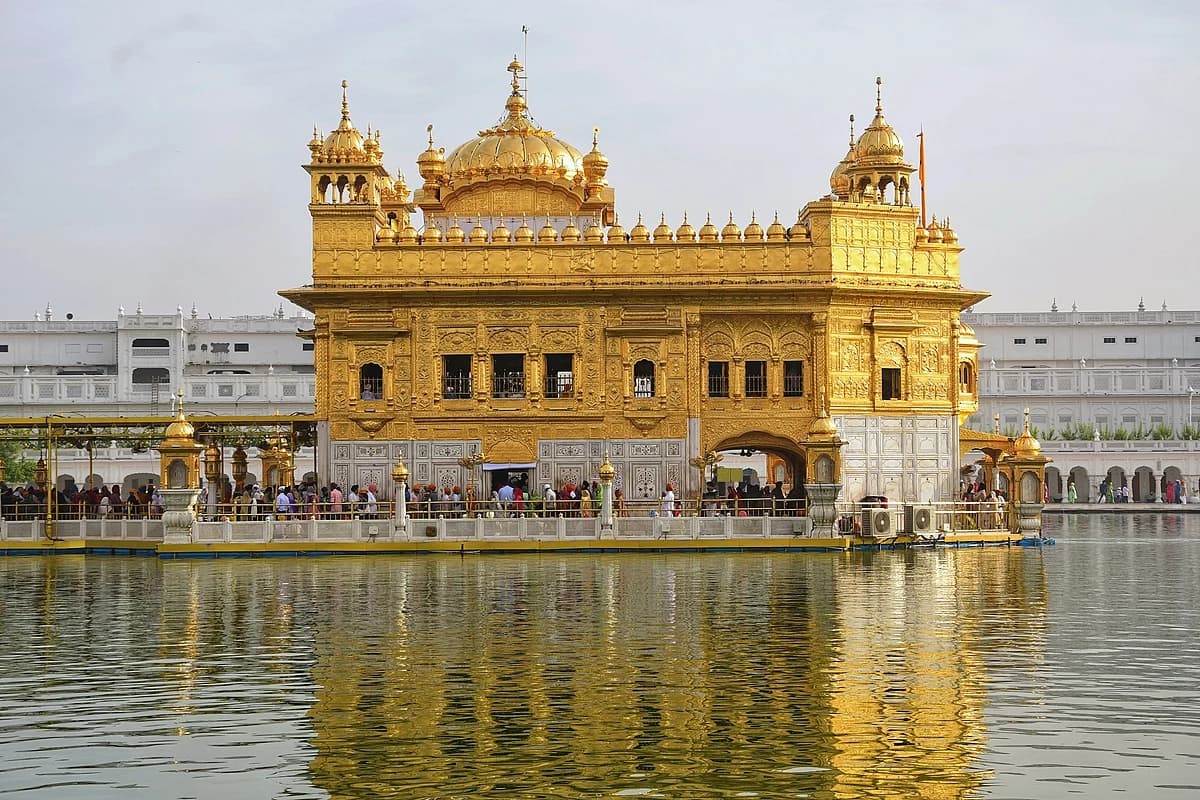
Golden Temple
Harmandir Sahib • The Holiest Gurdwara of Sikhism
About the Golden Temple
The Golden Temple, also known as Harmandir Sahib or Darbar Sahib, is the holiest Gurdwara (Sikh temple) and the most important pilgrimage site of Sikhism. It is located in the city of Amritsar, Punjab, India.
The temple was built by the fifth Sikh Guru, Guru Arjan Dev Ji, in 1604. The temple complex includes the main temple building, a large sacred pool (Amrit Sarovar), and several other buildings and shrines.
The Golden Temple is known for its stunning architecture, with the main building covered in gold leaf, and for its commitment to serving free meals (Langar) to all visitors regardless of their religion, caste, or social status. This tradition embodies the Sikh principles of equality, service, and community.
Historical Background
1577 - Foundation
Guru Ram Das Ji founds the city of Amritsar and digs the sacred pool.
1604 - Temple Construction
Guru Arjan Dev Ji completes the construction of the temple.
1762 - Destruction & Rebuilding
Afghan invader Ahmad Shah Durrani destroys the temple, later rebuilt.
1802 - Golden Covering
Maharaja Ranjit Singh covers the temple with gold leaf.
1984 - Operation Blue Star
Temple complex becomes the site of a major military operation.
Architectural Marvel
Design Elements
- • Central temple with golden dome
- • Sacred pool (Amrit Sarovar)
- • Four entrances symbolizing openness
- • Marble inlay work and frescoes
- • Blend of Hindu and Islamic architecture
Dimensions
- • Pool area: 150 square meters
- • Temple height: 12.5 meters
- • Complex area: 40 acres
- • Gold covering: 750 kg
- • Daily visitors: 100,000+
Best Time to Visit
Early Morning (4:00 AM)
Experience the peaceful morning prayers and fewer crowds.
Daytime (9:00 AM - 4:00 PM)
Explore the complex and participate in Langar service.
Evening (6:00 PM)
Witness the beautiful lighting and evening prayers.
Essential Visiting Tips
What to Bring
- • Head covering (scarf/bandana)
- • Modest clothing (cover shoulders/knees)
- • Socks (remove shoes before entering)
- • Camera (photography allowed)
- • Respectful attitude
Important Notes
- • Remove shoes before entering
- • Cover your head at all times
- • No smoking or alcohol
- • Participate in Langar (free meal)
- • Be respectful of religious practices
Langar - Community Kitchen
The Langar is a free community kitchen that serves meals to all visitors regardless of their religion, caste, or social status. This tradition was started by Guru Nanak Dev Ji and continues to this day, serving over 100,000 people daily.
How It Works
- • Volunteers prepare food 24/7
- • Simple vegetarian meals served
- • Everyone sits on the floor together
- • No discrimination based on status
How to Participate
- • Wait in line for your turn
- • Sit on the floor with others
- • Accept food with both hands
- • You can volunteer to help
Photography Guide
Best Photo Spots
- • Main Entrance: Darshani Deorhi with golden facade
- • Reflection in Pool: Temple mirrored in Amrit Sarovar
- • Clock Tower: Historical landmark
- • Langar Hall: Community dining area
- • Evening Lighting: Golden temple at sunset
Camera Settings
- • Aperture: f/8 to f/11 for sharp details
- • ISO: 100-400 for best quality
- • Shutter Speed: 1/125s or faster
- • Lens: Wide-angle (16-35mm) recommended
Nearby Attractions
Jallianwala Bagh
Historical garden where the 1919 massacre took place, now a memorial.
Entry Fee: Free
Wagah Border
Famous border crossing with Pakistan, known for the flag lowering ceremony.
Best Time: 4:30 PM (ceremony)
Partition Museum
Museum dedicated to the history of India's partition in 1947.
Entry Fee: ₹10 (Indians), ₹250 (Foreigners)
Gobindgarh Fort
Historic fort with museums, light shows, and cultural performances.
Entry Fee: ₹150 (Indians), ₹300 (Foreigners)
Frequently Asked Questions
Can non-Sikhs visit the Golden Temple?
Yes, absolutely. The Golden Temple welcomes visitors of all faiths, nationalities, and backgrounds without any restriction. This openness is central to Sikh philosophy — the four entrances of the temple symbolise that people from all four directions and all walks of life are welcome. The only requirements are to cover your head, remove your shoes, and wash your feet at the footbath before entering the inner complex.
What is the significance of the Langar at the Golden Temple?
The Langar is a free community kitchen that serves simple vegetarian meals to every visitor regardless of religion, caste, gender, or socioeconomic status. Everyone sits together on the floor to eat, symbolising equality. The Golden Temple Langar is one of the largest in the world, serving over 100,000 people daily (and up to 200,000 on major Sikh festivals). It is run entirely by volunteers (sevadars) and funded by community donations.
Is there a dress code to visit the Golden Temple?
Yes. All visitors must cover their head — scarves and bandanas are available free of charge near the entrance if you do not have one. Shoes must be removed and left at the shoe storage facilities outside the complex. Shorts, sleeveless tops, and revealing clothing are discouraged. Alcohol, tobacco, and non-vegetarian food are not permitted inside the premises.
Can I take photographs inside the Golden Temple complex?
Photography is permitted throughout most of the outer complex, including around the Amrit Sarovar (sacred pool), the bridge leading to the main shrine, and from the Parikrama (circumambulation path). Photography inside the inner sanctum (Harmandir Sahib itself) is not allowed during prayers. Be respectful and avoid using flash or disrupting worshippers.
What is the Palki Sahib ceremony and when does it take place?
The Palki Sahib (Golden Palanquin) ceremony marks the beginning and end of each day at the Golden Temple. In the morning (around 4:00 AM), the Guru Granth Sahib (the Sikh holy scripture) is ceremonially carried in a palanquin from the Akal Takht to the main shrine. In the evening (around 10:00 PM), it is carried back. Both processions are accompanied by singing of hymns and are deeply moving to witness. Arriving early morning gives you the best chance to see the Palki Sahib alongside the relatively small crowd.
What are the best times to visit to avoid crowds?
Weekday early mornings (4:00–7:00 AM) are the quietest times, when the atmosphere is spiritual and tranquil. Weekends, especially Sundays, and Sikh festivals such as Gurpurab (Guru Nanak Jayanti) see very large crowds — sometimes hundreds of thousands of pilgrims. If you want a peaceful experience, visit on a Tuesday or Wednesday morning. The temple is open 24 hours, so late evenings (after 9:00 PM) are also relatively quieter.
How far is the Golden Temple from the Amritsar Railway Station?
The Amritsar Junction Railway Station is approximately 2 km from the Golden Temple, about a 10–15 minute auto-rickshaw or cycle-rickshaw ride. The main road connecting the station to the temple, known as the Hall Bazaar Road, is a lively street lined with shops, food stalls, and guesthouses. Walking the route takes about 20–25 minutes and is a pleasant way to absorb the atmosphere of Amritsar.
Is there a shoe storage facility at the Golden Temple?
Yes. There are multiple free shoe-storage facilities (called "Juta Ghar") around the outer perimeter of the Golden Temple complex. Staff will store your footwear free of charge, though a small voluntary donation is appreciated. The facilities are clean and well-organised. You will need to wash your feet at the footbath just before entering the main complex — the cool water is also refreshing during summer visits.
Location & Map
The Golden Temple is located in the heart of Amritsar city, Punjab, India.
Address:
Golden Temple Road, Atta Mandi, Katra Ahluwalia, Amritsar, Punjab 143006
Coordinates:
31.6200° N, 74.8765° E
Quick Facts
Entry Information
Opening Hours
Best Visiting Times:
• Morning: 4:00 AM - 8:00 AM
• Afternoon: 2:00 PM - 4:00 PM
• Evening: 6:00 PM - 9:00 PM
How to Reach
Sri Guru Ram Dass Jee Airport (ATQ) - 11 km from Golden Temple
Amritsar Junction - 2 km from Golden Temple
Well connected by bus from Delhi, Chandigarh, and other cities
Auto-rickshaws and cycle-rickshaws available
Contact Information
Weather Guide
Local Cuisine
Amritsari Kulcha
Stuffed bread with potato filling
Punjabi Thali
Complete meal with multiple dishes
Shopping Guide
Phulkari Embroidery
Traditional Punjabi needlework
Juttis
Traditional Punjabi footwear
Punjabi Suits
Traditional ethnic wear
© 2026 TripGuides.in. All Rights Reserved.