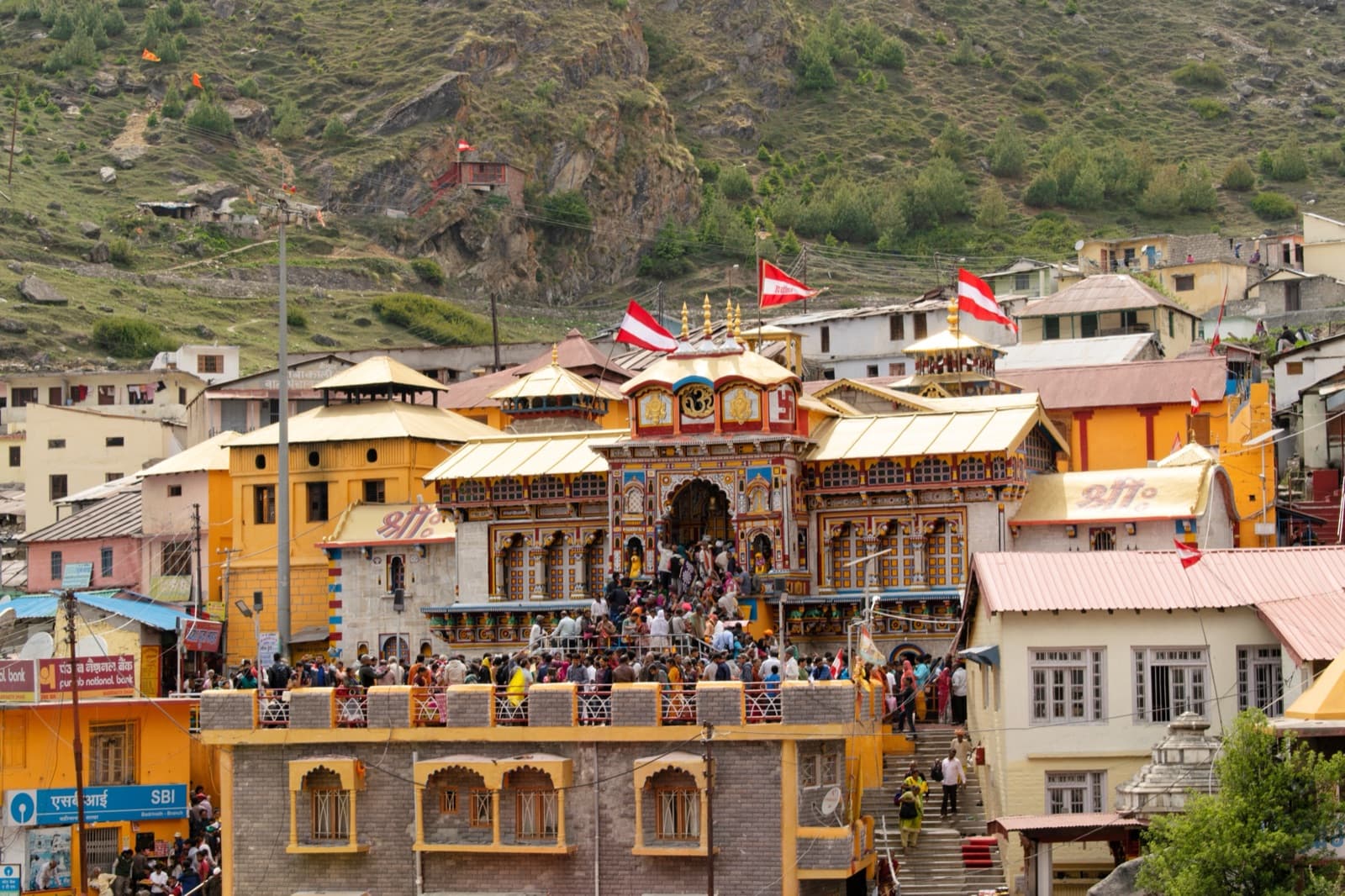
Badrinath
Abode of Lord Vishnu • Char Dham Shrine
About Badrinath
Badrinath is one of the holiest shrines dedicated to Lord Vishnu, worshipped here as Badrinarayan, and is part of both the Chota Char Dham of Uttarakhand and the grand Char Dham of India. Set at about 3,133 m beside the Alaknanda river and beneath the snow-capped Neelkanth peak, the brightly painted temple is believed to have been re-established by Adi Shankaracharya in the 8th century. Directly accessible by road, Badrinath draws millions of pilgrims each season and is complemented by the nearby Tapt Kund hot spring and the historic Mana village close to the Tibet border.
Highlights
- • Colourful temple of Lord Badrinarayan
- • Tapt Kund sacred hot-water spring
- • Neelkanth peak towering above the valley
- • Mana village & Bhim Pul (3 km away)
- • Vasudhara Falls trek beyond Mana
How to Reach
Jolly Grant Airport, Dehradun (~317 km) then by road
Drive to Badrinath via Rishikesh, Rudraprayag and Joshimath
Short walk across the Alaknanda bridge to the temple
~3 km onward to Mana, a village near the Tibet border
Frequently Asked Questions
Badrinath Temple opens around late April or early May and closes around mid-November, with exact dates announced each year by the temple committee. The closing date is typically fixed for an auspicious day after Diwali. During the winter the worship of Lord Badrinarayan shifts to the Narsingh Temple in Joshimath. Because Badrinath is part of the Char Dham circuit, its opening usually follows shortly after Kedarnath, Gangotri and Yamunotri.
Yes. Badrinath Temple is directly accessible by road and is the most motorable of the four Uttarakhand Char Dham shrines — vehicles reach the temple town itself via Joshimath along National Highway 7. From the parking area it is a short walk across the Alaknanda river bridge to the temple. The scenic route passes through Devprayag, Rudraprayag and the dramatic Joshimath–Badrinath stretch with its hairpin bends.
Badrinath is one of the most important shrines dedicated to Lord Vishnu (worshipped here as Badrinarayan) and is counted among both the Chota Char Dham of Uttarakhand and the larger Char Dham of India (with Dwarka, Puri and Rameswaram). It is also one of the 108 Divya Desams revered in Vaishnavism. The temple, set at about 3,133 m beside the Alaknanda and below the Neelkanth peak, is believed to have been re-established by Adi Shankaracharya in the 8th century.
The Tapt Kund is a natural hot-water spring located just below the Badrinath Temple on the bank of the Alaknanda river. Fed by underground geothermal sources, its waters remain warm even in the freezing Himalayan climate and are considered sacred. Pilgrims traditionally take a holy dip in the Tapt Kund to purify themselves before entering the temple for darshan.
Mana village lies about 3 km beyond Badrinath and is celebrated as one of the last villages near the India–Tibet border. It is a popular short excursion from Badrinath, with attractions such as the Bhim Pul (a natural rock bridge), Vyas Gufa and Ganesh Gufa caves, and the source of the Saraswati river. The route also marks the start of the trek towards Vasudhara Falls and Satopanth.
Registration for the Char Dham Yatra, including Badrinath, is mandatory and can be done online through the Uttarakhand government's official portal (registrationandtouristcare.uk.gov.in) or via the Tourist Care Uttarakhand app. Offline counters operate at Haridwar, Rishikesh, Joshimath and elsewhere along the route. Carry a valid photo ID and keep your registration confirmation accessible throughout the journey.
May–June and September–October are the best months, offering clear skies and comfortable conditions for darshan and sightseeing. The monsoon (July–August) brings heavy rain and a heightened risk of landslides on the mountain roads. The temple is closed from around mid-November to late April due to severe snowfall. Mornings are best for darshan, while afternoons can turn cloudy at this altitude.
Location & Map
Quick Facts
Essential Tips
What to Carry
- • Warm layers and a waterproof jacket
- • Comfortable walking shoes
- • Personal medication and first-aid
Good to Remember
- • Complete the mandatory yatra registration
- • Visit early for shorter darshan queues
Tourism Contacts
Photography Guide
- • Temple façade against Neelkanth peak
- • Steam rising from the Tapt Kund
- • Mana village and the Bhim Pul
© 2026 TripGuides.in. All Rights Reserved.